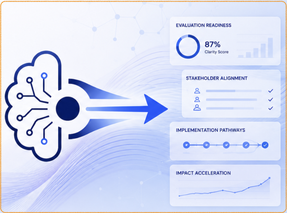
AI-supported workflow infrastructure for scientific evaluation, translational research, and innovation implementation.
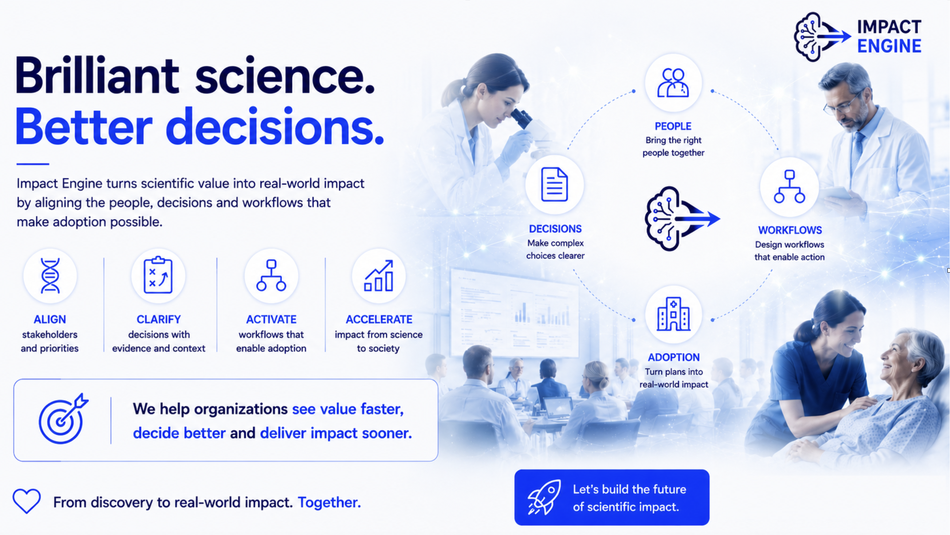
We help scientific innovation move more efficiently across evaluation, translational, commercialization, and implementation environments — while preserving scientific rigor and institutional control.
Strong science should not struggle to create impact simply because decision systems interpret value differently.
Impact Engine helps structure scientific expertise according to how real decisions are made.
THE PROBLEM
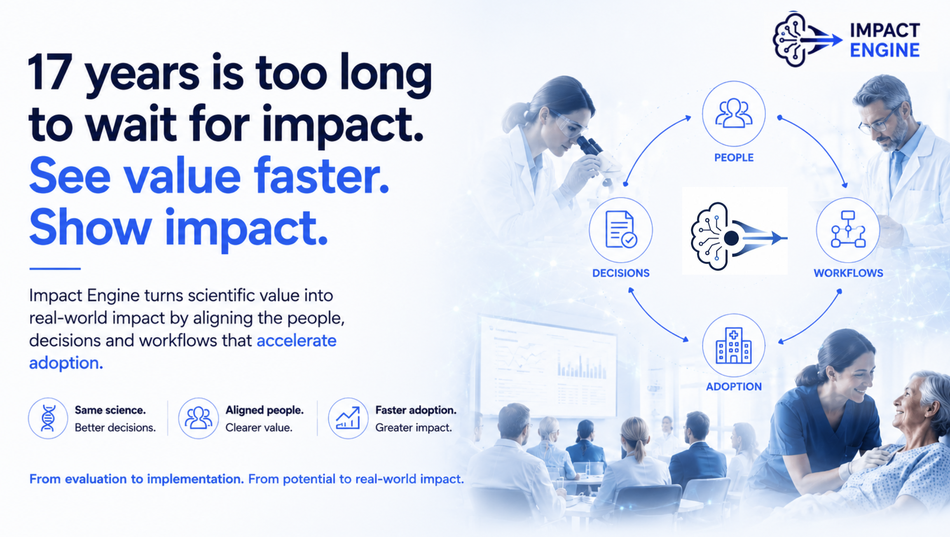
Research suggests that scientific evidence may take, on average, close to 17 years to move into routine clinical practice.
Yet even if this timeline were reduced from 17 years to 17 months, one bottleneck would remain:
valuable science becoming difficult to evaluate, compare, align, and implement across decision environments.
Scientific expertise repeatedly moves across grants, scientific committees, translational programmes, pharma partnerships, commercialization pathways, implementation discussions, investors, leadership, and patient communication.
The science may remain the same.
The logic for evaluating value changes.
Evidence. Feasibility. Risk. Timing. Adoption. Implementation.
WHY NOW
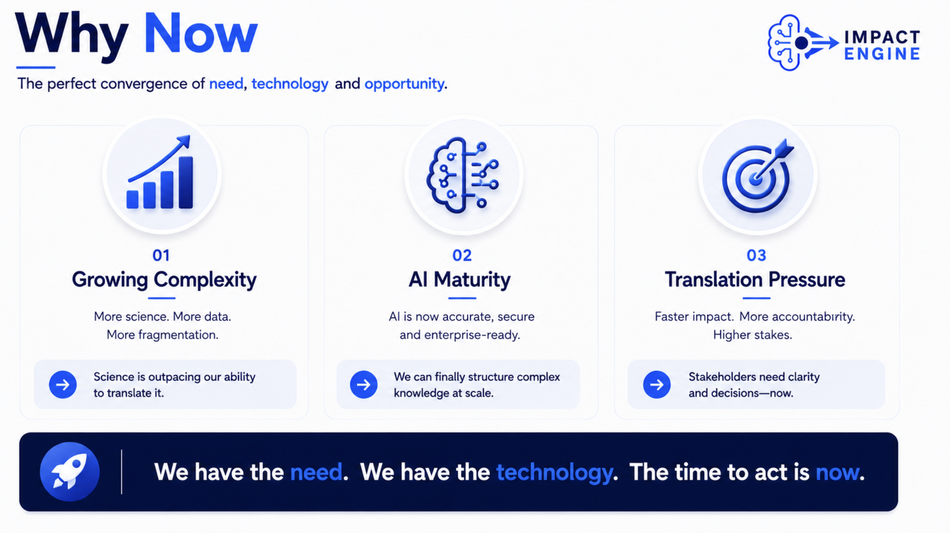
Several structural shifts make decision-readiness increasingly important in healthcare, pharma, research, and scientific innovation environments.
• AI adoption across institutional environments
• Growing scientific and organizational complexity
• Translational pressure between discovery and implementation
• Increased dissemination and commercialization expectations
• Cross-functional stakeholder environments
• Greater pressure for faster implementation and measurable impact
The challenge is no longer generating expertise.
The challenge is helping expertise become easier to understand where decisions are made.
WHAT IMPACT ENGINE DOES
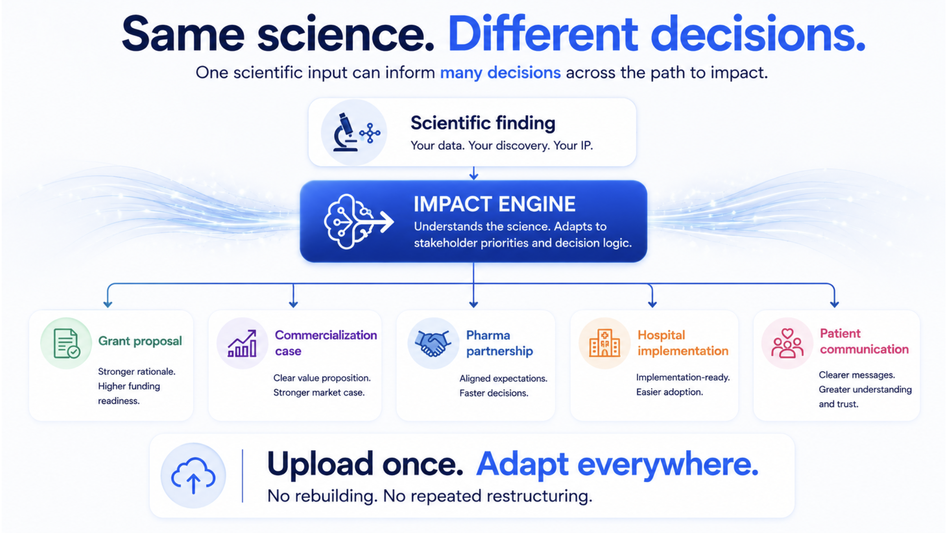
Impact Engine is an AI-supported workflow platform designed to help scientific and technical expertise move more effectively across complex evaluation and implementation environments.
Rather than generating science, the system helps structure existing expertise according to stakeholder logic, evaluation criteria, and real decision environments.
The objective is practical:
• reduce repeated restructuring work
• strengthen scientific visibility
• improve stakeholder alignment
• support translational workflows
• preserve scientific rigor
• accelerate implementation readiness
Generic AI optimizes outputs.
Impact Engine helps structure expertise according to how real decisions are made.
HOW IT WORKS
Scientific expertise repeatedly moves across multiple environments.
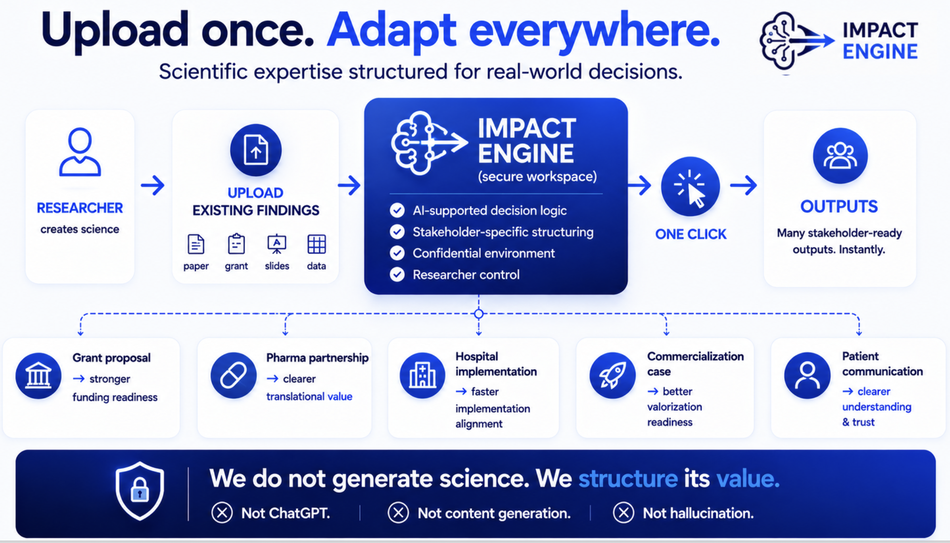
Impact Engine is designed to support structured adaptation while preserving rigor, researcher control, confidentiality, and institutional logic.
The workflow is simple:
Upload expertise once
→ AI-supported adaptation
→ predefined workflows
→ stakeholder-specific restructuring
→ clearer evaluation and implementation readiness
Potential environments include:
• grants and funding
• scientific evaluation
• translational programmes
• hospital innovation environments
• pharma partnerships
• commercialization pathways
• implementation teams
• patient-facing communication
WHO IT IS FOR
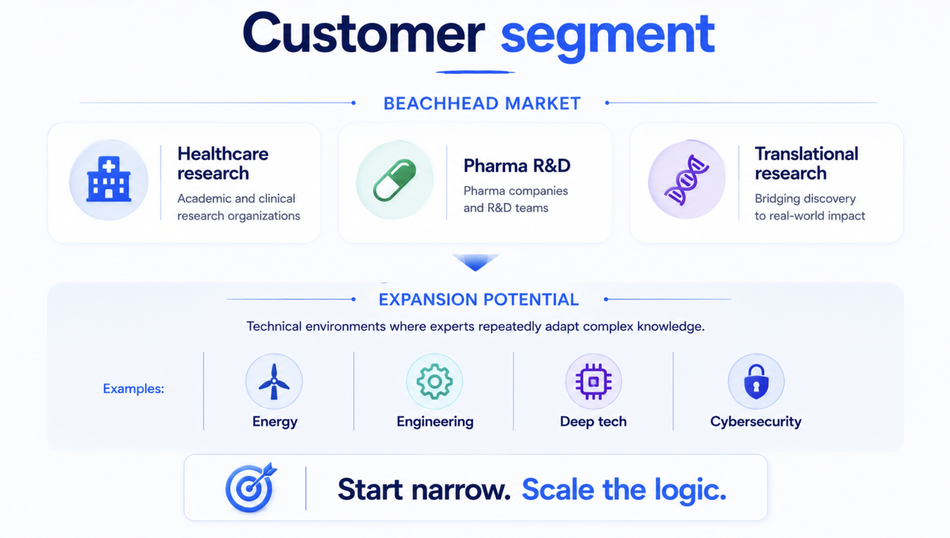
Impact Engine is being developed for organisations where scientific and technical expertise repeatedly moves across complex decision environments.
This includes:
Healthcare & Pharma
Support scientific evaluation, translational workflows, implementation readiness, and commercialization pathways.
Universities & Research Institutions
Reduce repeated restructuring work across grants, publications, committees, translational programmes, valorisation, and stakeholder communication.
Innovation & Startup Ecosystems
Help technical and scientific innovation become easier to evaluate, compare, align, and move toward adoption.
WHY CURRENT SOLUTIONS FAIL, OR why communication training alone is not enough
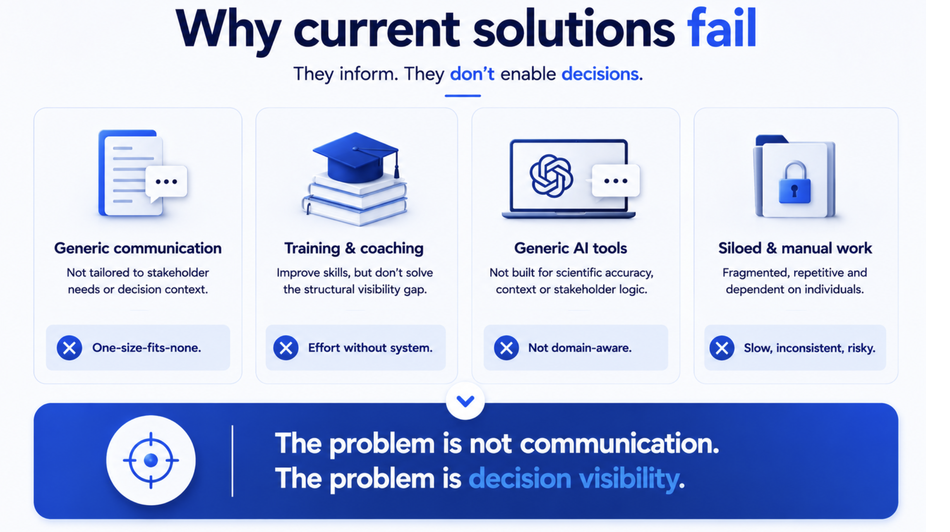
Many organisations respond to implementation friction with:
• presentation coaching
• communication training
• storytelling
• generic AI tools
These approaches may improve delivery.
They do not solve the deeper issue.
The challenge is not communication alone.
The challenge is decision visibility.
Generic AI generates plausible information.
Impact Engine helps structure expertise according to real evaluation logic.
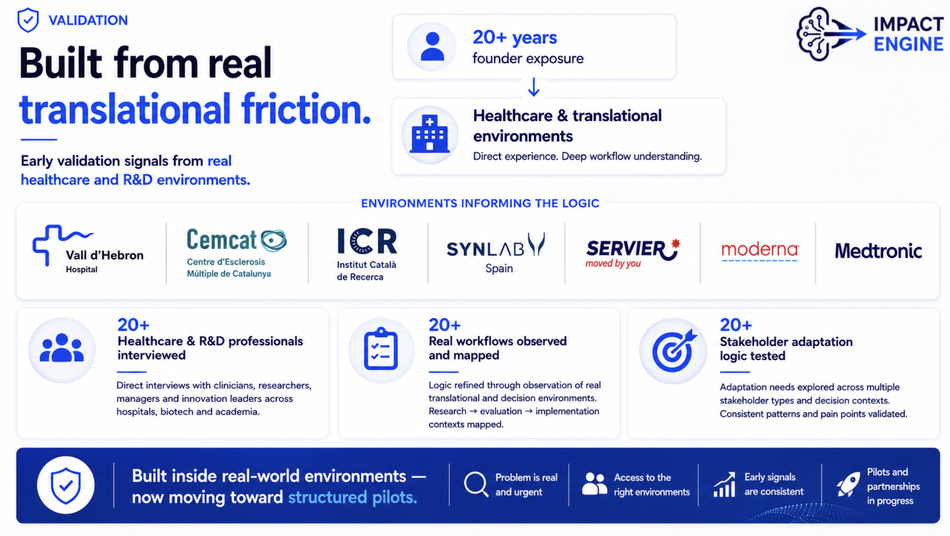
REAL-WORLD VALIDATION
Impact Engine is currently in an expert-guided validation stage informed by healthcare, research, and innovation environments in Spain and the Netherlands.
Early observations reveal recurring operational friction:
• repeated adaptation work
• slower implementation readiness
• translational bottlenecks
• fragmented stakeholder evaluation
• weaker visibility of scientific value
Current work focuses on understanding where expertise loses momentum and how structured decision-readiness may support stronger adoption and real-world outcomes.
IMPACT ENGINE VS GENERIC AI
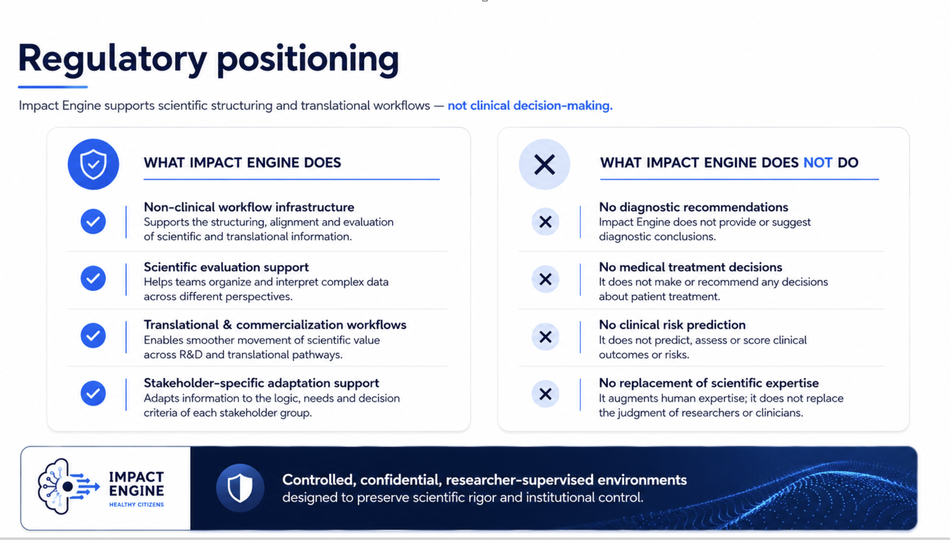
Impact Engine is not designed to replace scientific expertise.
It is designed to support institutional decision environments.
Impact Engine:
• works from existing expertise
• preserves scientific rigor
• supports confidentiality and institutional control
• operates inside structured workflows
• supports stakeholder-specific restructuring
• keeps human judgement central
We do not generate science.
We help structure its value.
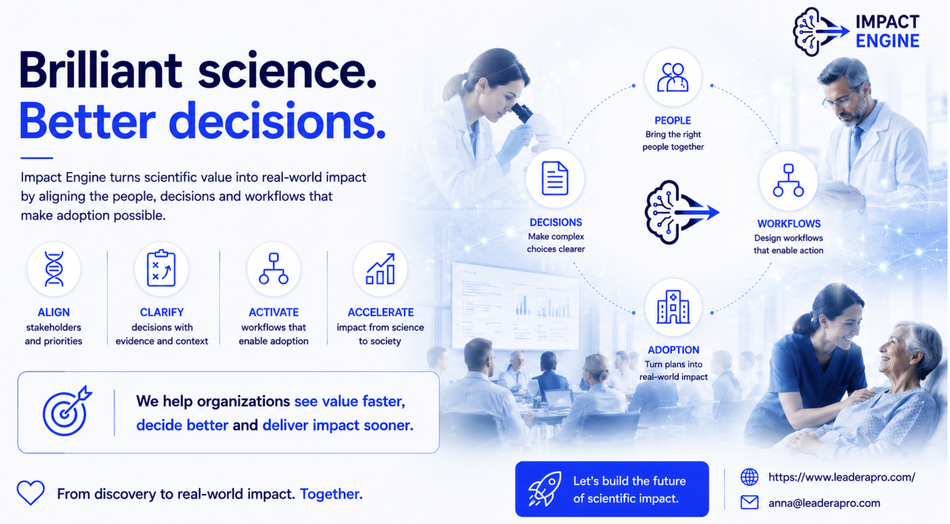
Strong science deserves faster impact
The next bottleneck in scientific innovation is no longer generating expertise.
It is helping expertise become decision-ready before valuable innovation loses momentum.
Impact Engine helps scientific value move faster toward implementation, adoption, and real-world outcomes.